GoalsWon vs Peer Accountability Apps: What Each One Is For

Joel
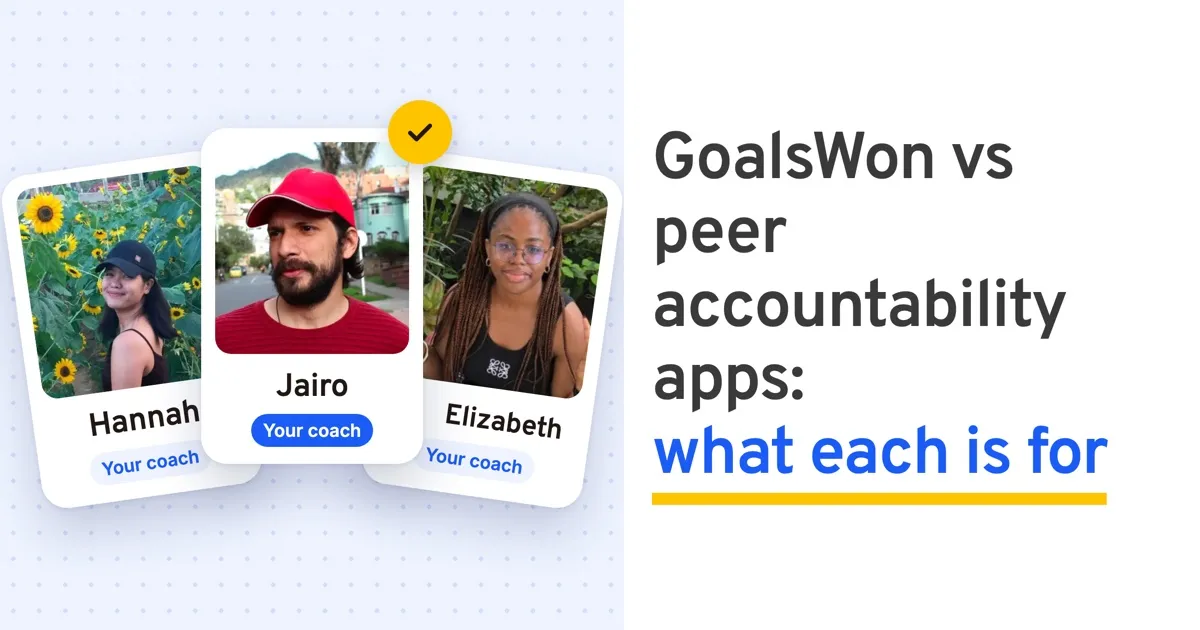
Peer accountability apps and GoalsWon do different jobs. Buddito introduces you to a real person so you can keep each other on track, and Cohorty lets you book an hour to do your habit quietly alongside other people. GoalsWon gives you one dedicated human coach who checks in with you by chat every day. Which one fits depends on what’s missing for you.
I co-founded GoalsWon and I still coach clients every day, so the bias is obvious. I’ll do my best to explain who each service is for, because I believe each one covers a different niche.
Jump to: what peer apps are, how GoalsWon is different, what GoalsWon is not, who should pick a peer app, FAQ.
What are peer accountability apps?
They’re apps where the accountability comes from someone other than a coach. The two I see mentioned most often work in quite different ways.
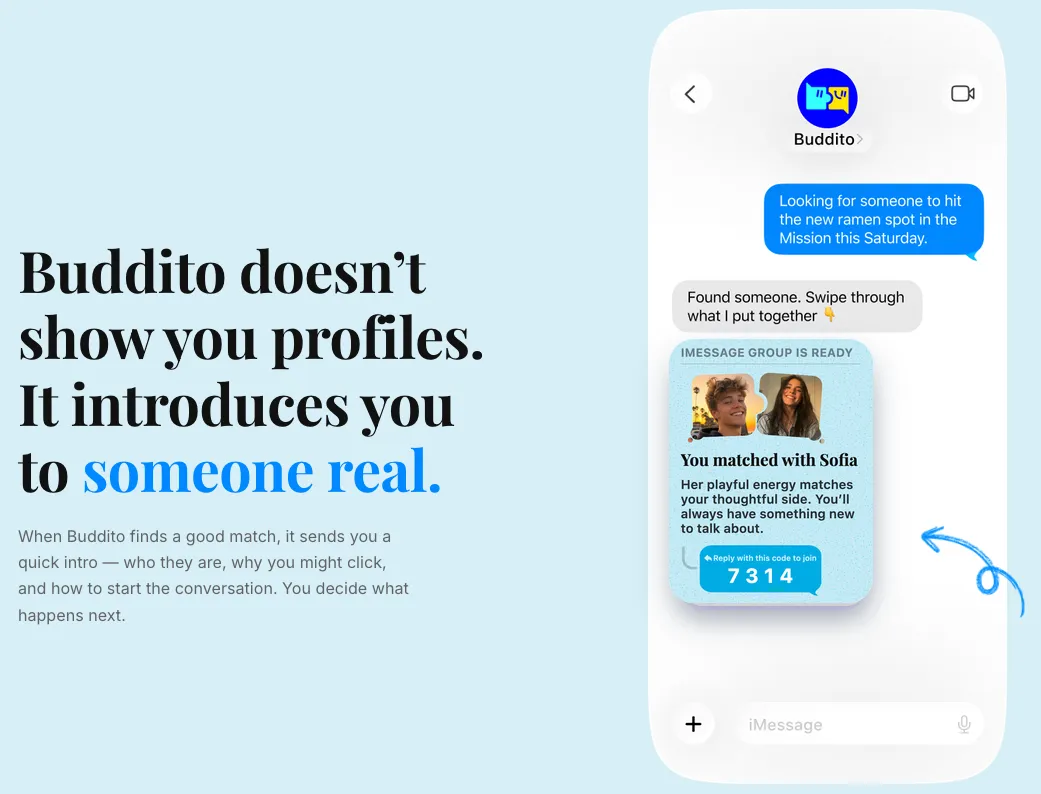
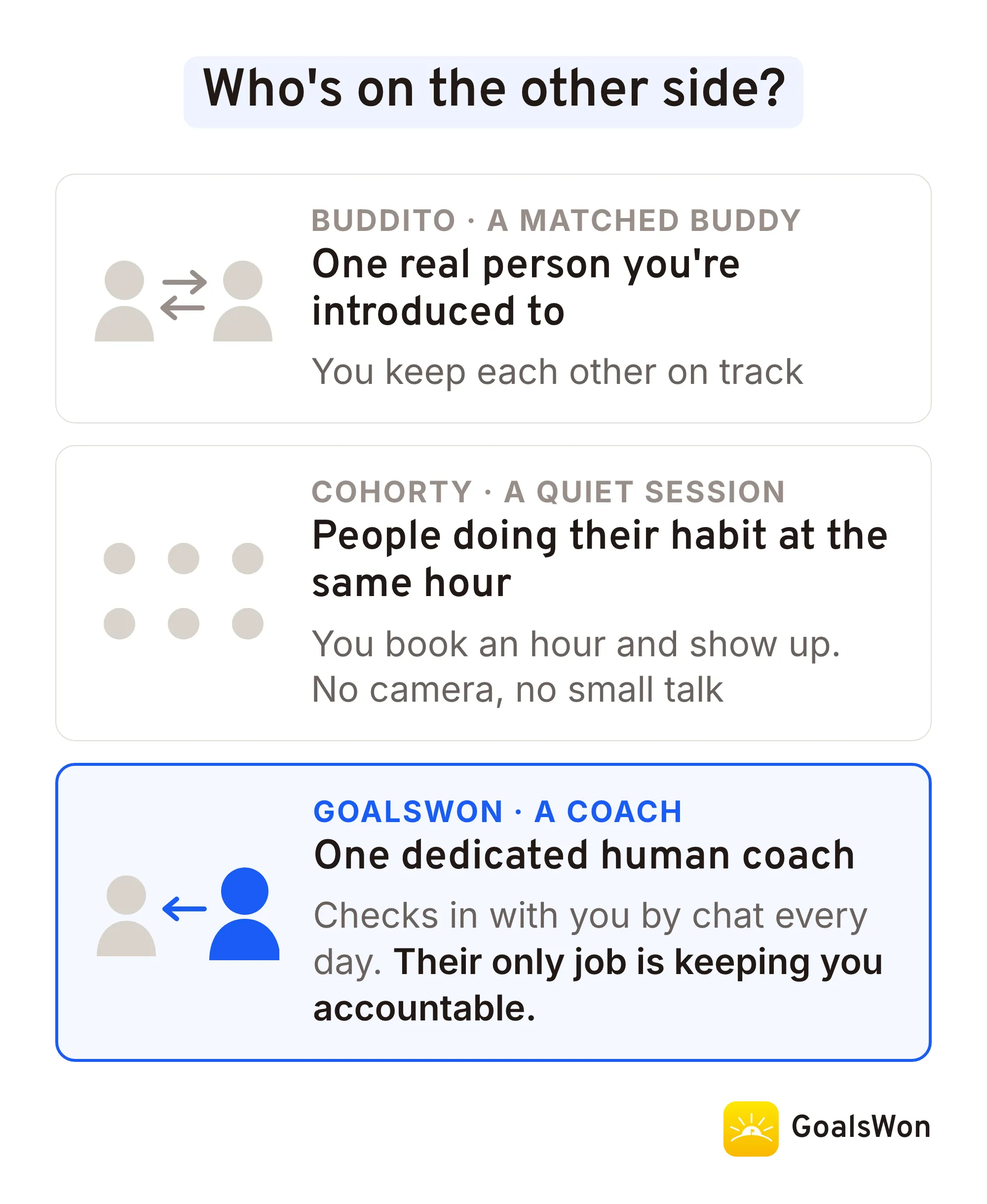
Buddito: a friend-matching service in iMessage. You text it the kind of buddy you want, for example a study buddy, a gym buddy or a 6am running buddy, and it introduces you to one real person and opens a group chat. Its site says it’s “free to start” with “no app to download”, and for now it lives in iMessage, so you need an iPhone. From there, the day-to-day accountability is between you and the person you matched with.
Cohorty: quiet habit sessions at a set time. You book an hour, start on the hour, and do your habit alongside other people. Its own pitch is “no camera, no small talk”. There’s a session every hour, and in each one you can leave a note, applaud the others and mark your habit done. Three sessions a week are free. The Plus plan costs $3 a month for unlimited sessions.
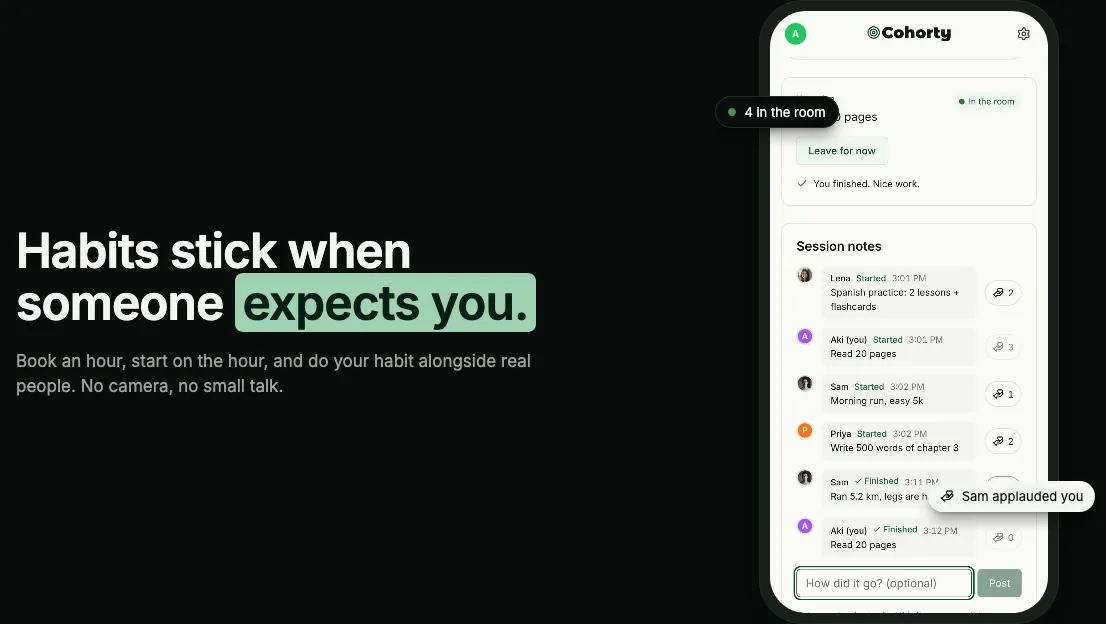
Two different ideas: a person you match with, and a group of strangers moving in parallel. Neither is trying to be a coach, and that’s fine. They’re built for a different need than coaching.
How is GoalsWon different?
GoalsWon is coaching, not matching. You get one dedicated human coach, trained in habits, procrastination and motivation. You check in once a day by chat with what you planned and what you did. Your coach reads it, replies, and keeps notes on what you tried, what worked, and the reasons you gave for wanting the goal in the first place. A monthly video call is included, and it works on iOS, Android and the web.
The biggest practical difference is who does the chasing. With a buddy, you’re both doing it for each other. With a coach, you don’t owe anything back. As Maria, one of our coaches, put it, this is “one dedicated coach whose only job is to keep you accountable. You don’t have to keep your coach accountable, of course, because this is not a peer-to-peer relationship.”
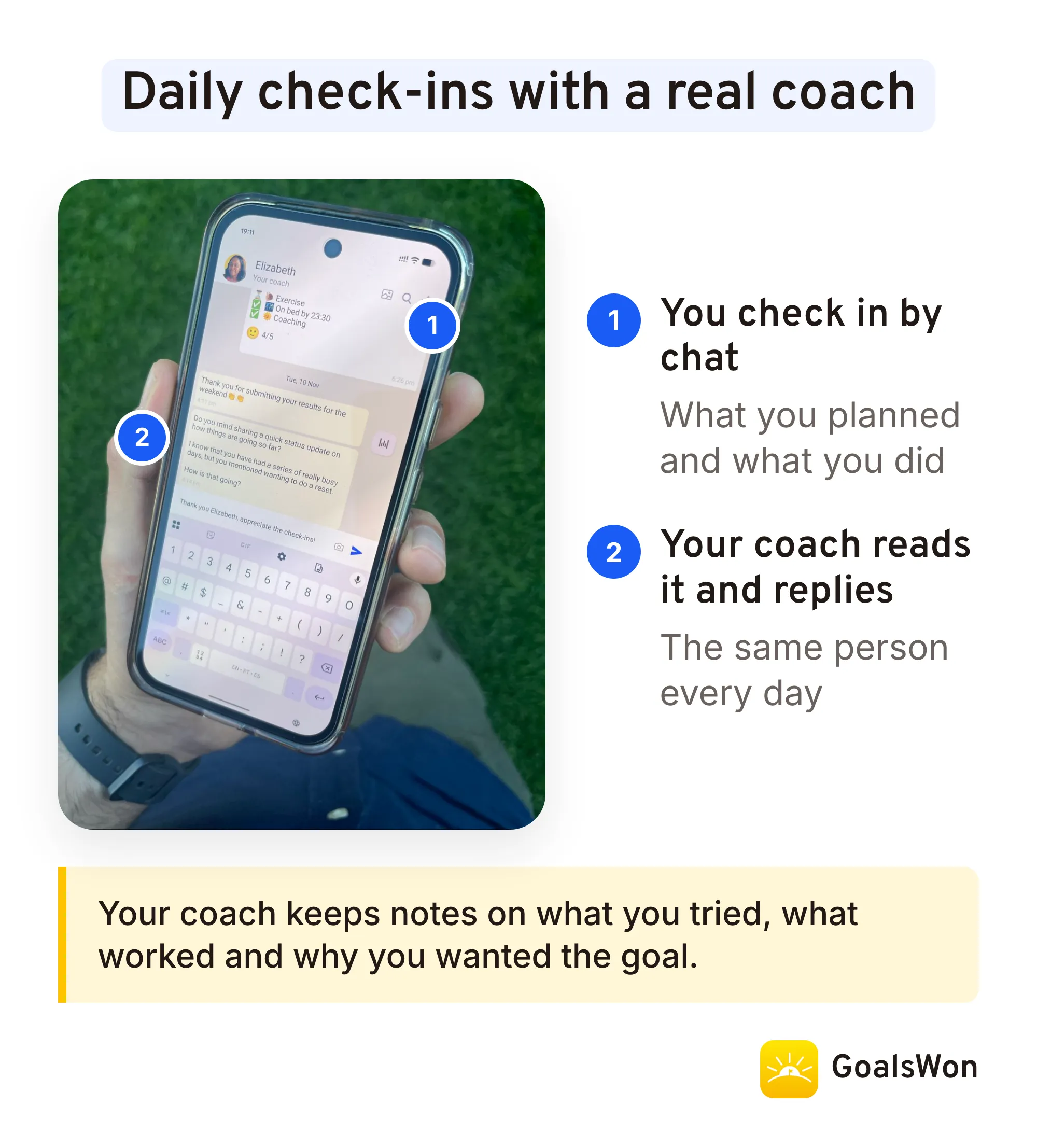
If you want the fuller picture of the daily work, we’ve written up how daily accountability coaching works, and the trade-offs of the free route are in accountability partner vs accountability coach.
| What it is | Who’s on the other side | What you owe back | Price | |
|---|---|---|---|---|
| Buddito | Friend matching in iMessage | One real person you’re introduced to | Whatever you and your match agree | Free to start, paid tiers not published |
| Cohorty | Hourly habit sessions, no camera | The people in the same session | Showing up at the hour you booked | Free for 3 sessions a week, or $3/mo for unlimited |
| GoalsWon | Daily accountability coaching by chat, plus a monthly video call | One dedicated human coach | Nothing, and honest replies help | $90/month, free trial included |
Competitor details from each app’s public pages, checked November 2026.
What GoalsWon is not
Since this page puts GoalsWon next to peer apps, here’s exactly how it works on the points people ask about most.
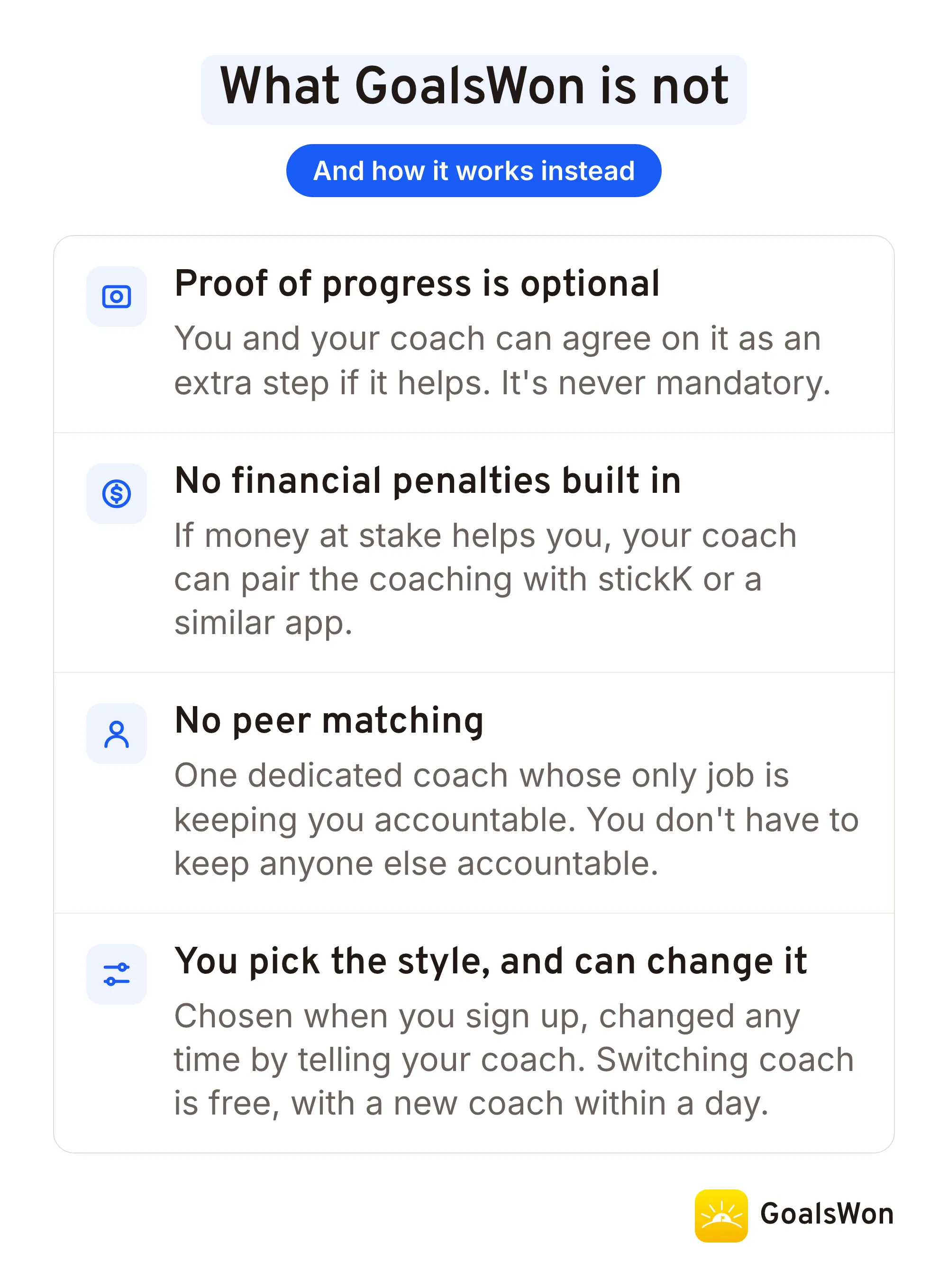
- Nothing has to be uploaded. Proof of progress, like a photo of the finished workout or a screenshot of the word count, is completely optional. Some clients do better with it, and sometimes a coach will suggest it as an extra step, but it’s always agreed between the two of you. The daily chat is the open channel, and the video call isn’t mandatory either.
- No financial penalties built in. The app doesn’t fine you. If money at stake helps you, and for some people who feel really stuck it makes a big difference, your coach will happily pair the coaching with stickK or a similar app that handles that part. By default, though, we’d rather understand why something isn’t working and fix it at the root, and recognise what is working, than punish the miss.
- No peer matching. One dedicated coach, the same person every day, and you never have to hold your coach accountable in return.
- You pick the style, and you can change it. At the start you choose how you want to be coached: accountability to your goals, motivation and encouragement, advice and practical tips, or discipline and tough love. You talk it through on the onboarding call. You can change it any time just by telling your coach, for example “be stricter about the gym” or “go easier on me this week”, and coaches adjust on their own when they can see an approach isn’t landing. If it still isn’t the right fit, you can request a different coach for free in the app. A new coach is assigned within a day and picks up where the last one left off.
Who should pick a peer app instead of a coach?
I’ve seen a specific kind of person do better with a peer app than with us. They can already prioritise and schedule themselves, and they handle both the tasks and the planning well. Their only problem is sitting down and not getting pulled away by something else in the moment. What they need is another person there while they work.
That’s a real need, and a daily coach isn’t the best answer to it. A daily check-in happens once a day. It can’t sit next to you at 10am while you open the document. If that’s you, a peer app or a co-working tool like Focusmate does the job better, and for a lot less money.
A peer app is likely the better fit if:
- Your planning is fine and starting is the problem. You know what today looks like, you just need someone there while you do it.
- You want the social side. A new friend, a language partner or a group that shows up at the same hour gives you something a coach doesn’t, and you might keep the friendship long after the goal.
- A light nudge is enough. If a daily “did you do it?” from a buddy or a quiet group keeps you moving, that’s the cheapest version of accountability that works, and you should take it.
- You’re happy to give as much as you get. A good peer arrangement is symmetric. If that sounds like a feature to you rather than a cost, it’s a great setup.
Who should pick GoalsWon instead?
People whose problem isn’t one session but the weeks around it. You plan something, it slips, and a week later nobody remembers what you tried. A coach brings that back. They know what worked in week one, they notice when you go quiet, and they keep checking in until you’re back, without you having to ask.
It also suits people who’d rather not carry someone else’s goals on top of their own. A buddy setup asks something back, and a coach doesn’t.
You don’t have to choose only one. Plenty of our clients use a peer or co-working tool for the moment of starting and a coach for the follow-through, and their coach checks in on both.
What does GoalsWon cost?
$90 a month with a 7-day free trial, or $720 billed once a year, which works out to $60 a month, with a 14-day free trial. Both plans include the daily coaching and a monthly video call, a weekly-call upgrade in the app makes it $150 a month in total, there’s no contract, and you can cancel anytime. The full breakdown, including who shouldn’t pay for any coach, is in our article on what an accountability coach costs, and the plans are on the pricing page.
Two boundaries, so you don’t buy the wrong thing. Our coaching is a daily rhythm, one proper check-in a day via chat plus the monthly call, not someone pinging you through the day. And a coach is not a therapist, a personal trainer or a business advisor. If you need one of those, hire that professional, and let the coach help you show up for it.
Where this leaves you
Peer apps and coaching are different tools for different needs. If what’s missing is a person on the other side while you work, or a friend, or a light daily nudge, a peer app is the right buy. If what’s missing is someone who knows your history and keeps asking on the weeks you’d rather not answer, the free trial is the simplest way to find out whether a daily coach is the version that works for you.
GoalsWon vs peer accountability apps: FAQ
What is the difference between GoalsWon and a peer accountability app?
A peer accountability app connects you with other people working on their own goals: a matched buddy, or a group doing their habits at the same hour. GoalsWon gives you one dedicated human coach who checks in with you by chat every day, keeps notes on what you tried, and follows up when you go quiet. They are different tools for different needs, and your own preferences decide which one fits.
Does GoalsWon make you upload proof of your goals?
No. Nothing has to be uploaded. Proof of progress, like a photo or a screenshot, is optional. Some clients like it as an extra layer of accountability, and sometimes a coach will suggest it, but it is always agreed between you and your coach. The daily chat is the main channel, and the monthly video call is there if you want it.
Does GoalsWon charge you money when you miss a goal?
There are no financial penalties built into GoalsWon. If having money at stake helps you, your coach will happily pair the coaching with a tool like stickK that handles that part. By default, coaches focus on understanding why something isn’t working and fixing it at the root, and on recognising what does work.
Is GoalsWon a peer matching or accountability partner app?
No. There is no peer matching. You get one dedicated coach whose job is to keep you accountable, and because it isn’t a peer relationship, you never have to hold your coach accountable in return.
Can I choose how strict my GoalsWon coach is?
Yes. You pick the coaching style you want at the start, for example accountability to your goals, motivation and encouragement, practical tips, or tough love, and you talk it through on the onboarding call. You can change it any time by telling your coach. If it still isn’t the right fit, you can request a different coach for free in the app, and a new coach is assigned within a day and picks up where the last one left off.
Who should use a peer accountability app instead of a coach?
People who already plan and prioritise well, and whose only struggle is sitting down and staying on one thing in the moment. If you know exactly what to do today and just need another person on the other side while you do it, a peer or co-working tool is a good fit and costs far less than a coach. Peer apps also suit anyone who wants the social side, a new friend or a group doing the same thing.