
Accountability Partner vs Accountability Coach: When Free Is Enough and When It Stops Working

Joel
An accountability partner is free, and it works well when you find someone reliable, willing to call you out, and on a schedule that overlaps with yours. Most partnerships fade within a few weeks, though, because nobody is paid to keep going. An accountability coach costs $60 to $90 a month with us, or $200 to $500 on other platforms, and is paid to keep asking. Which one you need comes down to whether the missing piece is a nudge or a person.
I co-founded GoalsWon and I still coach clients every day, so the bias is obvious: one of the two options on this page is my business. The other one is actually how my business started: before GoalsWon existed I tried accountability with friends, then with partners from Reddit, then in a Discord server where people posted their goals and vanished within a week, and one of the few who stuck around was Simon, who went on to become my co-founder.
The long version of that story is in our guide to accountability apps. The short version is that I’ve been on both sides of this comparison, and I’ll tell you when the free side wins.
Jump to: when a partner is enough, why partners stop working, what a coach does that a friend can’t, “I already know what to do”, which to choose, FAQ.
What’s the difference between an accountability partner and an accountability coach?
The direction of the effort. A partner is a peer doing you a favour, and you owe them the same favour back, whereas a coach is someone you pay to do the chasing, which means the arrangement survives the weeks when you don’t feel like being chased.
| Accountability partner | Group or co-working stranger | Accountability coach | |
|---|---|---|---|
| Cost | Free | Free to about $12/mo |
|
| Who it is | A friend, colleague or someone you matched with online | Whoever shows up that day | The same person every time, trained in behavioural science and science-backed productivity techniques, and you can switch for free if it isn’t the right fit |
| How often | Whatever you both agree, usually weekly, until it slips | Per session you book | Daily with us, weekly or monthly on most other services |
| Who chases whom | Both of you, equally | Nobody, you book the next one yourself | They chase you |
| When you go quiet | Usually one “you ok?”, then it gets awkward and stops | Nothing happens | They message first, then email, help you adjust the plan, and keep at it until you’re back |
| When you miss a day | Usually “no worries, it’s ok!” | Nothing, and no-shows happen on their side too | You get called out, then help to understand what happened and how to recover |
| Your obligation | Do the same for them | Show up to the session | A subscription, and honest replies |
The partner column describes the typical case, not the best one. A great partner beats a mediocre coach, and free is a real advantage, which is why the rest of this article is about when it holds up. Coach prices are typical published rates, and the full comparison with sources is in our cost article.
| What you get | Accountability partner | Group or co-working stranger | Accountability coach |
|---|---|---|---|
| Free | ✅ usually yes | 🟡 sometimes | ❌ usually no |
| Someone who already knows you | ✅ usually yes | ❌ usually no | ❌ usually no |
| The same person every time | ✅ usually yes | ❌ usually no | ✅ usually yes |
| Checks in on you every day | ❌ usually no | ❌ usually no | ✅ usually yes |
| Chases you when you go quiet | 🟡 sometimes | ❌ usually no | ✅ usually yes |
| Calls you out on a missed day | 🟡 sometimes | ❌ usually no | ✅ usually yes |
| Keeps notes on what you tried and what worked | ❌ usually no | ❌ usually no | ✅ usually yes |
| Trained in habits, procrastination and motivation | ❌ usually no | ❌ usually no | ✅ usually yes |
| Works when your schedules don’t match | ❌ usually no | 🟡 sometimes | ✅ usually yes |
| No obligation to do the same for them | ❌ usually no | ✅ usually yes | ✅ usually yes |
Partner and group columns describe the typical case, not the best one. ✅ usually yes · 🟡 sometimes · ❌ usually no
When is an accountability partner enough?
When the check-in runs on a system, not on anyone’s motivation. Every free arrangement I’ve seen work for more than a few weeks had at least one of four things going for it, and the easiest way to show them is through people who have sat in front of our coaches. The stories below are real cases from our own coaching, with names and details changed to protect everyone’s privacy, and you may well recognise yourself in one of them.
A group with rules, not just a friend. Marcus, a sales manager in his forties with two young kids, belongs to a fitness group that assigns every member a partner and expects a proof photo each day, and as his coach put it to me, the group “has got his workout goals covered”. What he uses GoalsWon for is everything the group doesn’t reach: being present at home, sleep, his own headspace, the things that keep the workouts sustainable in the first place. That isn’t the free option failing. It’s the free option working exactly as far as it was ever going to.
A narrow, shared goal. Ana, a nurse in her thirties, has painted with the same small group every other Thursday for two years, and in all that time nobody has had to chase her about it, because the evening has a date, a room and people who notice an empty chair. What she hired a coach for was work and health, the two areas of her life with no group behind them. Another client shares her meals in an online community and keeps the app “because of the daily check-in and feedback”. In both cases the partnership covers one area cleanly, and nobody expects it to cover everything else.
Overlapping schedules. Priya was studying for a professional licensing exam around shift work when she found a study partner online who was preparing for the same kind of exam, and for one day it was perfect. Then her shifts moved and his nine-to-five didn’t, and within a week they were leaving each other messages instead of studying together. Her coach’s view was that free works “when both people have similar goals and their schedules work well together”, and it’s the second half of that sentence that people tend to skip.
Structure that comes with the job. Dana, a freelance copywriter, stopped using us when she took a staff role with a fixed office routine, because the commute, the desk and the colleagues were exactly the structure she’d been paying for. She came back when the contract ended and her days went shapeless again, and there was nothing wrong with either decision. If your life already supplies the structure, buying more of it is a waste.
Jeremy Nagel, who runs the productivity app Focus Bear, described his own version of this in a review of GoalsWon written 18 months into using it: a weekly call with a few friends where they set intentions and report back, which he still keeps several years on. He also wrote that it’s “easy to get a bit slippery and come back every week without having made much progress”, so he kept the group and added a coach for the consistency.
That stacking pattern shows up again and again, a partner or a group for the area it covers and a coach for the rest. A reviewer on Trustpilot described using GoalsWon “to supplement therapy, my personal trainer, and my family support network” for the one thing none of them provided, which was daily accountability. If you have a partner who works, keep them.
And a last honest point in the free column: if what you want is the social side of accountability, coffee with a friend who keeps you in check, no online coach fully replaces that, and a blogger who reviewed us put it well when he said we’re best for “those without in-person accountability, no trainer, mentor, or accountability buddy nearby”.
Why do accountability partners stop working?
To answer this I asked our coaching team what their clients had told them about the partner, friend or spouse they tried before GoalsWon. This is what they shared:
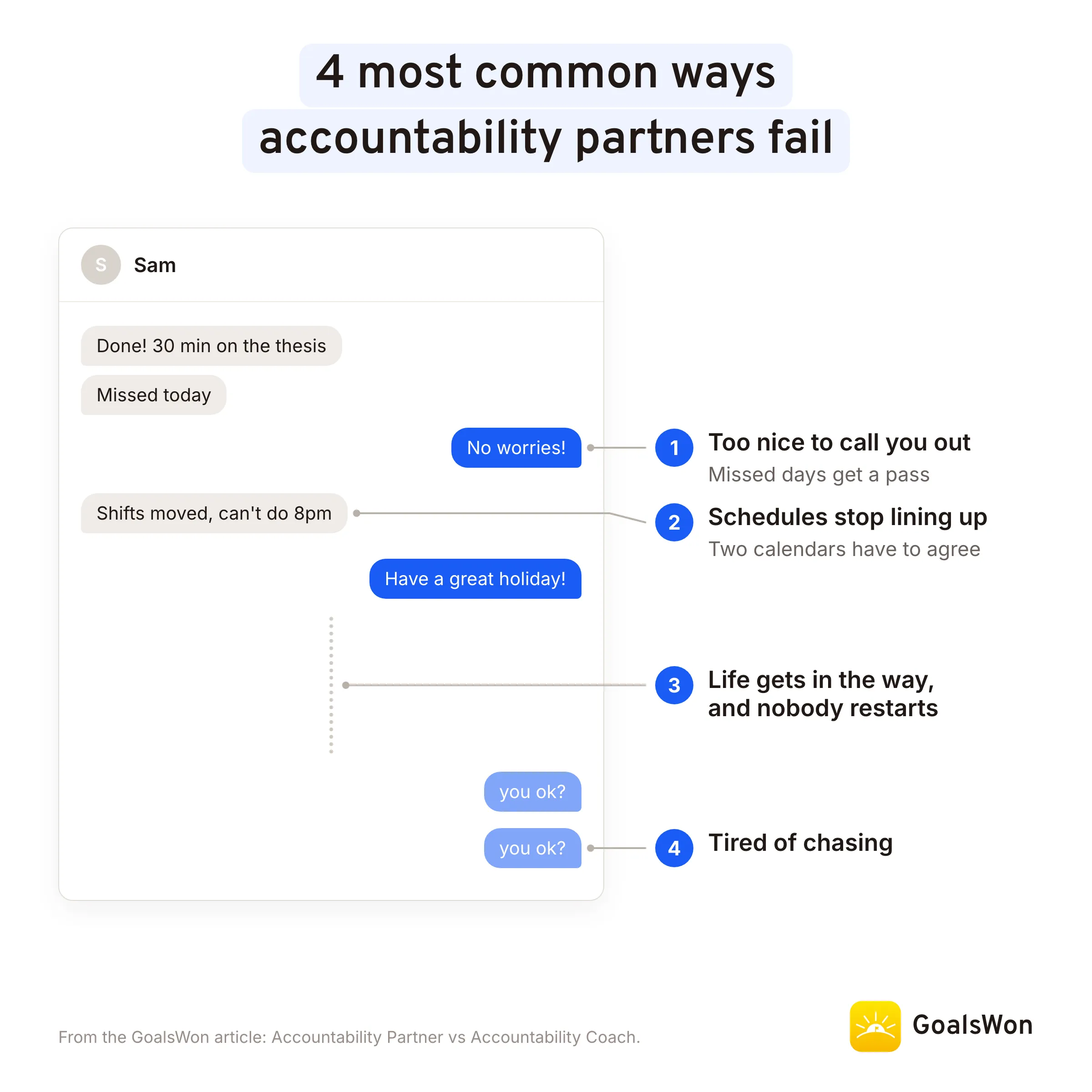
The partner won’t confront you
This is the big one, and every coach had a version of it. Clients told Maria, one of our coaches, that their partner “wasn’t hard enough on them”, that when the moment came to hold them accountable “they wouldn’t confront them”, and that where money was on the line the partner would simply forgive the debt. Bianca heard the same thing from every client who’d tried it: it started well, the partner “lacked authority”, and the client fell behind. Cristine described a small-business owner who’d tried a group and her friends and found they “were never as consistent with a daily check in while at the same time being lenient because they are friends”, which is both failures in one sentence.
Our customers say the same thing in public. This is a client of ours writing on Trustpilot after trying the friends-and-family route first:
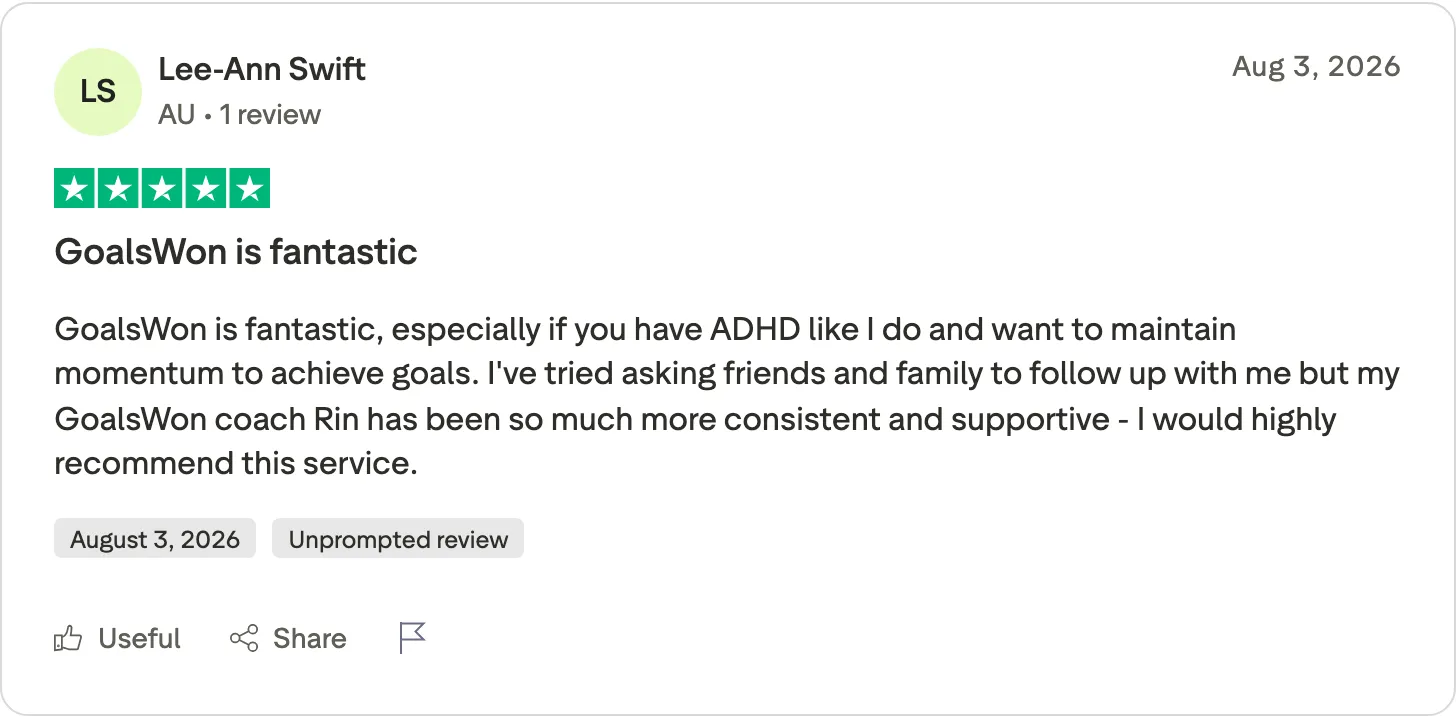
Jeremy, the Focus Bear founder from earlier, gave the problem a section heading in his review: “Sometimes friends are too nice.” And that’s not a character flaw. A friendship is built to be kind, so a friend who pushes hard on the third missed day is spending the friendship to do it, and most people, sensibly, decline to spend it.
It can fail in the other direction too. Our coach Elora told me about a client who’d asked a mentor from his religious community to keep him accountable, and it “didn’t work well because he found her too strict”. Strictness without a method behind it just makes you avoid the person. The job is to be firm about the goal and kind about the person, every day, and that balance is hard to hold when you’re doing it as a favour.
The partner gets tired of chasing
One of our coach Hannah’s clients had a friend doing daily check-ins by text and the occasional call, and it “died down after a while”, because the goals weren’t getting done and “it became tiring for the friend to check in regularly”. Guillermo put the contrast bluntly: some clients go inactive several times a month for months on end, and “at some point a friend gets tired of following up, but we don’t”. Chasing someone who’s hiding is unpleasant work, and it happens to be exactly what we’re paid for.
Life interrupts and nobody restarts it
Holidays, illness, travel, a family event. Our coach Rin listed exactly those as the reasons her clients’ arrangements with friends and family ended, and the mechanism is always the same: the check-ins pause for a perfectly good reason, and then nobody wants to be the one who says “shall we start again?”, because that sounds like an accusation. With a paid coach the restart isn’t a favour anyone has to ask for. It’s the default.
Schedules stop lining up
This is where the stranger route usually dies, and it’s why Priya’s study partner lasted one day past the schedule clash. One of Guillermo’s clients tried a co-working tool and kept getting matched with partners who “cancelled the commitment before the call”, enough times that he gave up on it altogether, and one of Jairo’s had tried group workouts that fell apart because “it was hard to set up schedules that worked for all parties”. A partnership needs two calendars to agree, every time, indefinitely, whereas a coach only needs yours.
The cost nobody mentions: it’s symmetric
A good partner calls you out, reminds you why you started, and notices when you go quiet, and if you find one you owe them all of the same. That’s a second person’s goals to hold in your head, on top of your own, for as long as the arrangement lasts. Some people love that, and it’s how I met my co-founder.
Most people, though, once they’re a few weeks in, find they wanted the accountability without the second job. And the guilt cuts the other way too: Divina, another of our coaches, told me the arrangements she’d heard about often ended not because the friend got tired, but because the client “felt bad for taking up their partner’s time”. Guilt about the favour kills as many partnerships as leniency does.
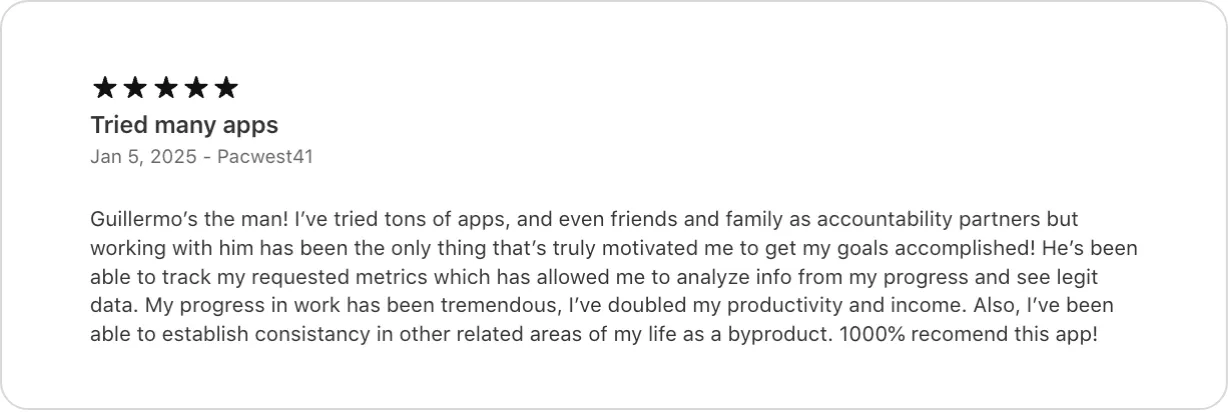
One App Store reviewer had been through the whole list before finding a coach:
One more warning, about the partner you live with. Several of our clients tried making a spouse or partner the accountability partner first, and more than one arrived because the partner was the one who went looking for an alternative. The pattern they describe is the same every time: each missed goal becomes a small broken promise to the person you love, and after enough of them the goal has cost you trust at home as well as progress. A neutral third party carries none of that history, which is most of the point of hiring one. If you’d still like your partner in the loop, the app lets you nominate them as a supporter who gets your progress updates, without making them the one who has to enforce anything.
What does an accountability coach do that a friend can’t?
Not “be a professional”. One of our coaches put it more modestly than I would: it’s not that a friend couldn’t do any of this, it’s that “not all friends will do” it. So rather than talk about training in the abstract, I went back through my own notes on the first week with the last 34 clients I coached myself, looking for the specific moves at specific moments. The lines quoted below have names, goals and details changed so nobody is recognisable, including to themselves, and I’ve left out anything I wouldn’t want read back to me.
What a friend structurally can’t do is this:
Ask four questions on day one, and keep the answers. What exactly needs doing, why it matters to you, what usually gets in the way, and what you’ve already tried. A friend knows roughly what you want, whereas a coach makes you say precisely what will count as done (“30 minutes of joke writing in the morning”, not “writing”) and writes down your reasons so they can be brought back later. Sofia, a teacher starting a side business, wrote a paragraph on her first day about why her goals mattered to her, and her coach replied that he’d “added these thoughts into your goals’ description, so we can revisit them regularly”, which is exactly what happened.
Message first the morning after a bad day. Not “how’s it going?” and not silence. Ben, a lawyer who’d signed up to learn Portuguese and get back to the gym, had a day where urgent work ate everything and he skipped both, and the next morning his coach wrote: “Could you find some time today for a quick workout, even if it’s just 15 minutes? When building a habit, it’s very important not to skip two days in a row.” The reply came back within the hour: “Fair point re the workout, I’ll make sure I do that this evening.” A friend’s version of that message is “no worries, it’s ok!”, which is kind and changes nothing.
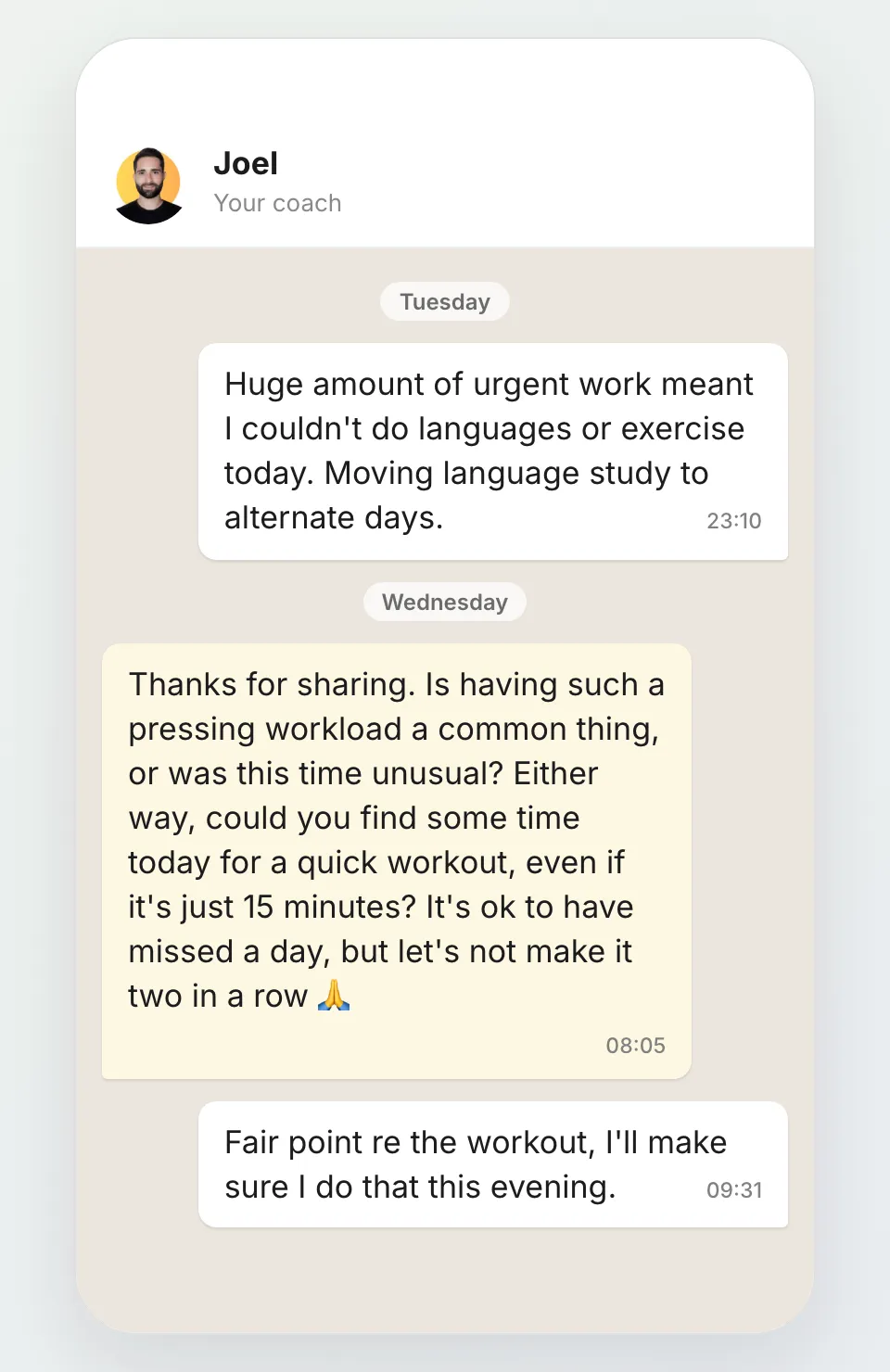
Looking across those 34 first weeks, the message after a slip does four things every time, and they’re the four things a friend can’t comfortably do. It arrives before being asked, it gives credit for whatever did get done without absolving the rest, it shrinks the task to a number for today (15 minutes, half the emails, under ten hours of screen time), and it changes the plan or asks what got in the way, so the same failure is less likely tomorrow.
Take goals away. The most common thing I do in a client’s first week is cut their list, from seven daily goals to two, from five new habits to one, from thirty minutes of language study to ten. A friend who’s cheering you on will not tell you your plan is too big, but one of my first-week messages, verbatim, is: “Can we focus on just 1-2 goals first? Let’s make sure you’re getting a 100% done of your plan, even if at the beginning it’s not an impressive one.” People don’t buy accountability expecting to be told to do less, and it’s the part that works.
Keep a record, and bring back what worked. “One week ago you mentioned that leaving your phone in another room was helping you focus. Are you still doing that? If not, why?” That’s a message I send often, and it only works because I have the notes. Every check-in, every reason you gave on day one, every workaround that helped and every one that didn’t goes into the record, so the advice you get in week six is built on what actually happened in weeks one to five rather than on what either of us remembers. That record is the method. A friend remembers that you were doing better for a while, whereas a coach remembers what you were doing differently, and can put it back in front of you.
Keep going when you hide. When a client stops opening the app, the coach keeps checking in, then emails, then offers a reset or a call. One coach’s description: “With friends, after a day or two, they’d be gone. But with us as coaches, we tend to stay and find ways to bring them back.” Another put it as “insisting every day, week, month without fail, and repeating this each time they get inactive throughout the whole year.”
Our clients describe the effect more sharply than we do. A founder trying to send a hundred cold emails in a week wrote on his first day: “If you sense I’m full of BS, please call me out.” An accountant, a few days in: “Please keep up the guilt trip if I forget!” And the clearest, from a student who’d had three red days in a row and then did one small thing: “Kept my phone on the table before sleeping. Why? Wanted to do at least one task since you asked.” Nobody asks a friend for the guilt trip. You have to pay someone for permission to give it to you.
Which raises the obvious idea: why not pay a friend $20 a month? If that works for you, do it, and I mean that.
In my experience it doesn’t, because paying your friend was never the problem and it won’t be the fix either. A paid friend still has a friendship to protect, still has no notes on what you tried in week one, and still has nothing to fall back on when “come on, you said you would” stops working. What you’re buying from a coach is someone with no stake in staying on your good side, a method for the third missed day, and a record of what worked, and if the person you get isn’t the right fit, switching coaches is free and your history moves with you.
One client tried the do-it-yourself version of that before us, and hired and trained her own accountability person:
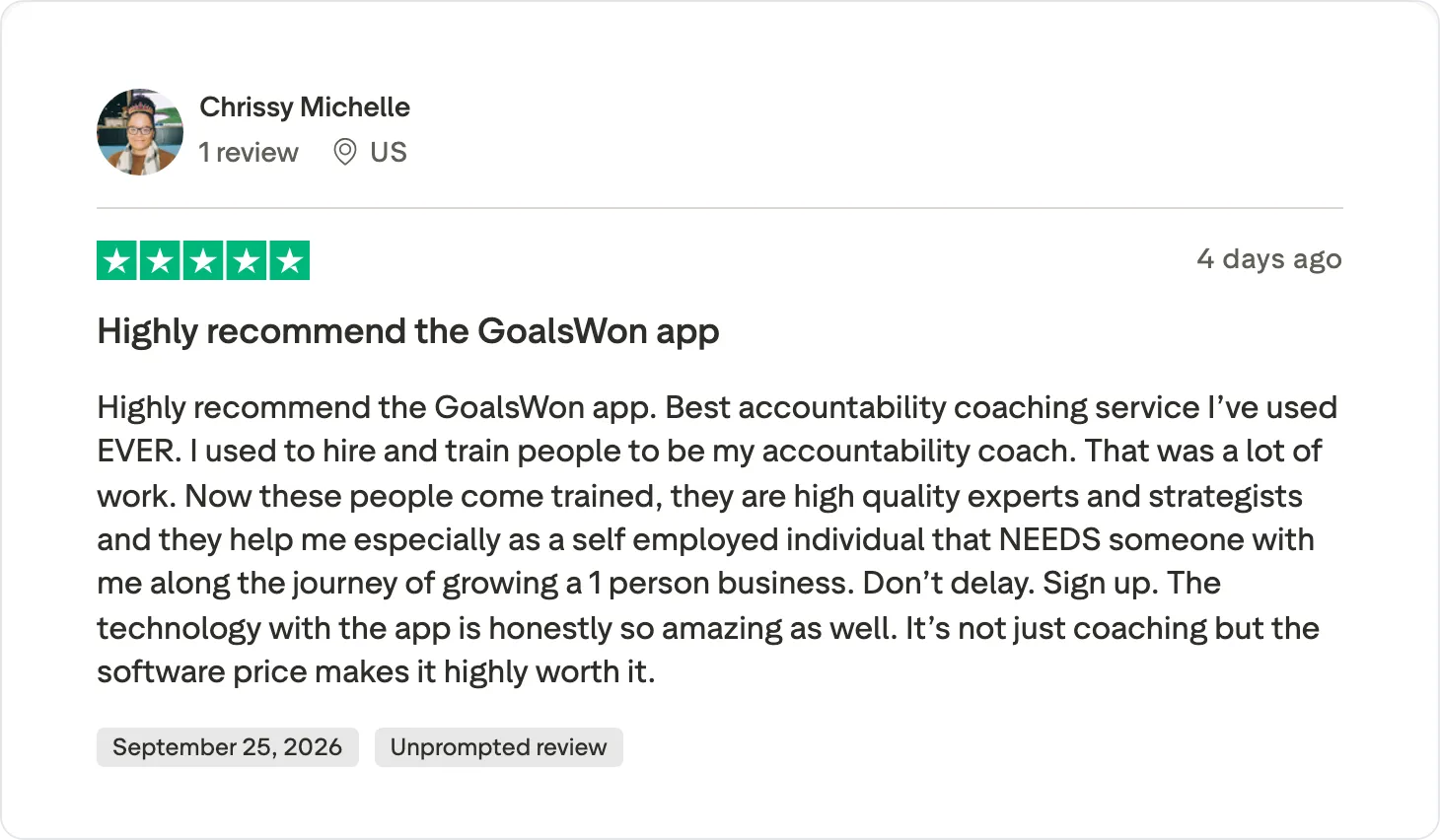
If you want the fuller picture of the daily work, we’ve written up what an accountability coach does all day, and the daily accountability coaching page explains how the check-ins fit together.
”I already know what to do.” Do you need either?
Almost everyone who comes to us already knows what to do. Of those 34 first weeks, 28 clients said some version of it, and while that’s my own count from my own notes rather than a study, the same sentence turns up in our public reviews often enough that I trust it.
One client who’d been in and out of gyms for a decade put it in nine words: “I have worked out quite a bit, I know how, but I don’t do it.” A consultant wrote: “While it is easy for me to talk about what I want to do, I struggle with discipline and execution.” And a five-star App Store reviewer summarised the whole category: “I had all the solutions, but lacked the push to put them into action.”
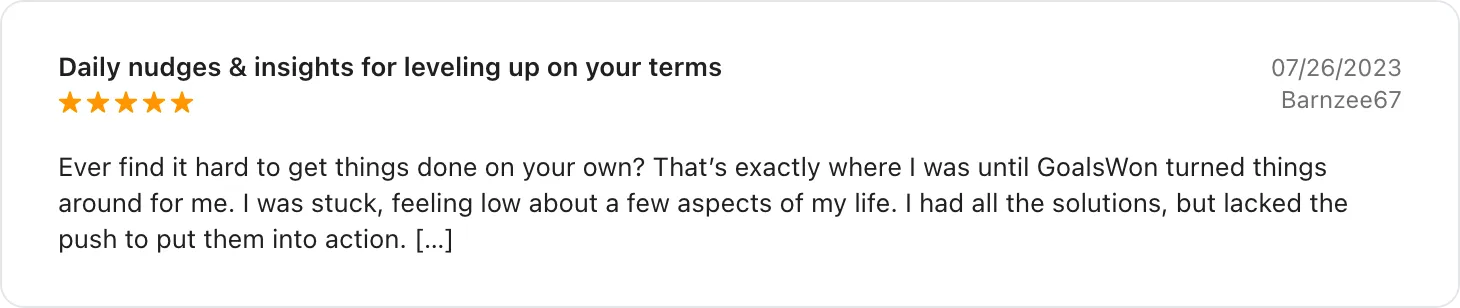
So knowing what to do isn’t the bottleneck, and neither a partner nor a coach will give you information you don’t already have. What they give you is someone who expects to hear from you, and the test of whether you need that is your own history rather than your intentions. If you’ve tried apps, streaks, blockers and a friend, and each one worked for a couple of weeks before you quietly stopped, then the thing that’s missing is a person. If a reminder on your phone is enough to get you moving, buy the reminder.
One more piece of honesty from those first weeks: almost nobody gets a clean one, with a coach or without. The difference is what happens on day three. With a partner, day three is when the check-ins start to feel awkward, and with a coach, day three is when the plan gets smaller and the questions get more specific.
Which should you choose?
I don’t think a coach is always worth it, and I’d rather you pick right than pick us.
- Get a partner or join a group if you have a specific friend or community in mind, the goal is narrow and shared, your schedules overlap, and you’re happy to do the same work for them. This is the ideal outcome, it’s free, and you might make a good friend along the way, so try it before you pay anyone.
- Use a co-working tool like Focusmate if your problem is starting rather than sticking. Booking a session with a stranger at 9am is a strong way to open the laptop, even if it won’t notice that you skipped last Thursday, and some of our clients use both, with “book a Focusmate session” as one of the goals their coach checks on.
- Use a referee app if you don’t need the social side of accountability and what you mostly want is a way back on track when you slip. Some people just need a small penalty for missing, a tool that fines you or asks for proof, and that does the job for a few dollars. Our list of accountability apps covers the good ones, and for those people a coach is overkill, which I’d say on the onboarding call that comes with the trial.
- Get a coach if you’ve already been through the free options, you know what to do, and what you’re missing is someone who keeps asking on the weeks you’d rather not answer. That includes people who only need it for a while, because some clients use us to get out of a rut, build the routine, and leave, and that’s a perfectly good use of it.
A simple way to decide
- Start free. Ask the one person or group you already have in mind, and agree a fixed check-in, same time, same place, so it doesn’t depend on anyone remembering.
- Check after two weeks. Did the check-in still happen on the days you went quiet, and did anyone say something when you missed? Yes to both means you have the ideal version. Keep it.
- Pay when the check-in stops happening. If it faded, or you ended up carrying it for both of you, that’s the point where a coach earns the money: someone whose job is to ask, with notes on what you tried, on the weeks you’d rather not answer.
And the terms, so nothing surprises you at checkout: $720 billed once a year, which works out to $60 a month, with a 14-day free trial, or $90 month to month with a 7-day free trial. Both include the daily coaching and a monthly video call, there’s no contract, you can cancel anytime, and you’re not charged during the trial. The detail is on our pricing page.
Two boundaries, so you don’t buy the wrong thing. Our coaching is a daily rhythm, one proper check-in a day via chat plus that monthly call, not someone pinging you at lunch to ask if you started. If you want structure inside the day itself, a co-working tool does that better.
And a coach is not a therapist, a personal trainer or a business advisor. If what you need is a workout programme or mental health help, hire that professional, and let the coach make sure you show up for it. The full list of who shouldn’t pay for an accountability coach, with real prices, is in our cost article.
How do you find an accountability partner if you go the free route?
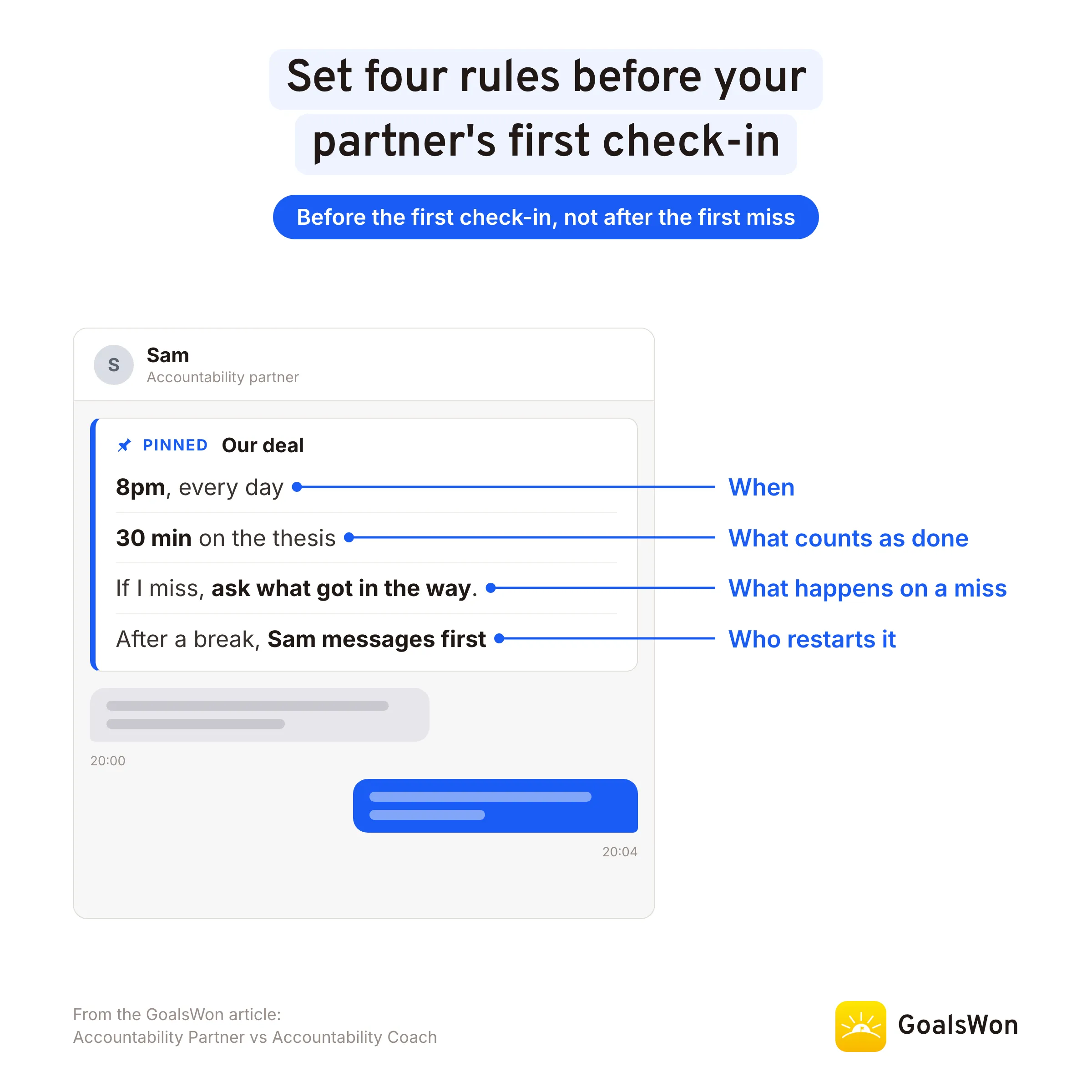
The same way I did. Subreddits like r/accountability and r/Accountabilibuddies, Discord accountability servers, and co-working tools. It’s a lottery, but the odds improve a lot if you set the rules before the first check-in instead of after the first miss:
- When. A fixed time, ideally daily, at worst twice a week. “Whenever” is the first thing to die.
- What counts as done. Say the number. “30 minutes on the thesis” survives, “work on the thesis” doesn’t.
- What happens on a miss. Agree that the partner asks what got in the way, and that “no worries” is not an acceptable reply. This is the rule people can’t keep, and it’s the one that matters.
- Who restarts it. After a holiday or a bad week, whose job is it to send the first message? Pick a name.
Then give it two weeks. If they’re still there, you’ve found something valuable, so hold onto it, do your half of the work, and you won’t need the rest of this page. If they ghost, which is the most common outcome, it’s the nature of free peer accountability and not a verdict on you. Try again with clearer rules, or with a group instead of one person.
Where this leaves you
Accountability works, and most people who come to us already know that, because a trainer, a friend or a group has proved it to them once. The hard part was never the idea, it was finding someone reliable enough to keep doing it. If you have that person, keep them. If you’ve been through the free options and what’s missing is someone who keeps asking, the free trial is the cheapest way to find out whether a daily coach is the version that sticks.
Accountability partner vs accountability coach: FAQ
Is an accountability partner better than an accountability coach?
For some people, yes. A partner is free, and if yours is reliable, willing to call you out, and on a schedule that overlaps with yours, that’s the ideal setup. The catch is finding that person and keeping them. Most partnerships fade within a few weeks because nobody is paid to keep going. A coach costs money precisely so that the checking in doesn’t depend on goodwill.
Can a friend be my accountability partner?
Yes, and it’s worth trying before you pay anyone. Agree four things up front: when you check in, what counts as done, what your friend should say when you miss, and who restarts it after a break. The usual failure isn’t that friends don’t care. It’s that they’re too nice to push, and after a few missed days it feels awkward for both of you, so the check-ins quietly stop.
Can my spouse or partner hold me accountable?
They can, but be careful. Several of our clients tried it first and found it strained the relationship, because every missed goal became a small broken promise to the person they live with, and after enough of them the goal had cost trust at home as well as progress. A neutral third party carries none of that history.
What does an accountability coach do that a partner doesn’t?
A coach keeps going when a friend would stop. The next morning after a bad day, a coach messages first, gives you credit for what did happen, shrinks the task to something you can do today, and changes the plan so the same thing doesn’t happen tomorrow. Weeks later, a coach brings back the reason you said you started, and the trick that worked in week one that you’ve since dropped. A friend rarely has the time, the notes, or the experience to do that.
Is an accountability coach worth it if I already know exactly what to do?
Knowing what to do is where almost everyone starts. Of the last 34 people I coached through their first week, 28 said some version of “I know what to do, I just don’t do it”. If reminders and streaks are enough to get you moving, a cheap app or a friend is the right buy. If you’ve already tried those and quietly stopped, the missing piece isn’t information, it’s a person who expects to hear from you every day.
Why pay a coach when a roommate or parent could check in every week for free?
If they will, and they keep doing it, don’t pay. In practice a weekly check-in from someone who loves you tends to become a conversation about how you’re doing rather than whether you did the thing, and it fades when life gets busy for either of you. What you’re paying a coach for is the daily, slightly uncomfortable version that doesn’t fade, from someone with no stake in staying on your good side.
How much does an accountability coach cost?
Other coaching services typically run $200 to $500 a month, usually built around a weekly or monthly call. GoalsWon is $720 billed once a year, which works out to $60 a month, with a 14-day free trial, or $90 month to month with a 7-day free trial. Both include daily chat coaching and a monthly video call, no contract, cancel anytime. We’ve written up the full accountability coach cost comparison, including who shouldn’t pay us.
Where can I find a free accountability partner?
Subreddits like r/accountability and r/Accountabilibuddies, Discord accountability servers, and co-working tools like Focusmate, which has a free plan. Treat the first two weeks as a trial. If the person is still showing up after that, you’ve found something valuable. If they ghost, which is the most common outcome, it’s the nature of free peer accountability rather than anything you did.
.B3r7fsvG_g5zEm.webp)