
What Does an Accountability Coach Do? A Real Coach's Answer

Joel

An accountability coach helps you follow through on the goals you already have. In practice that means regular check-ins (daily, in GoalsWon’s case), help choosing what to commit to, straightforward questions when you don’t follow through, and steady adjustments to your plan, so that your progress runs on a system instead of on sheer motivation.
That’s the short answer.
The longer answer is more interesting, because most of the job is invisible from the outside. I’m a co-founder at GoalsWon and I still coach people every day. This is what the work actually looks like, with real numbers from real coaching logs.
What does an accountability coach do every day?
Every morning I open each person’s board. At the top I can see their big priorities for the year, the targets we agreed for this month, and how each day goes. Then, one person at a time:
- Compare yesterday’s plan with what actually happened. If something planned didn’t happen, I ask about it the same day: was the plan too optimistic? Did something get in the way? Procrastination? The goal is to catch friction while it’s one bad day, not after it’s a bad streak.
- Reply to whatever they sent. Questions, wins, worries, a screenshot of a rough draft. The reply matters because of who it comes from: someone with your full context. People often can’t recognize their own wins, or lose perspective in the middle of a slog. Part of the job is holding the big picture for them and pointing at progress they can’t see from up close.
- Follow up on today’s plan. If it isn’t set yet, I ask for it, and suggest goals that fit what we’re working toward.
- Flag goals that have stalled. A goal that hasn’t moved in a few days gets a heads-up: what’s happening with this one? Should we reschedule it, shrink it, or change the approach?
- Prepare for what’s coming. If something important is scheduled in the coming days, I send a reminder so they walk in prepared.
- End with one question. I try to close every message with a question that prompts reflection about the day. My real job, condensed to one sentence: make sure no day passes without the person reflecting on it.
And to answer the question every skeptic should ask: yes, it’s a real person doing this, every day. (You can see who our coaches are on the GoalsWon coaches page.)
Additionally, I keep notes on everyone I coach so I can follow up on things they mentioned weeks ago. And when someone shares an insight about themselves (“I focus better when I plan the night before”), I save it. Months later, when they’re stuck, I can hand them back their own words, which lands far better than any generic advice.
The effect is something like a journal that talks back, with questions that are targeted because they come from someone who actually knows you.
What actually happens in your first weeks?
In my experience, most people arrive the same way: motivated, and carrying too much. New sleep schedule, exercise, a side project, a career move, all starting Monday.
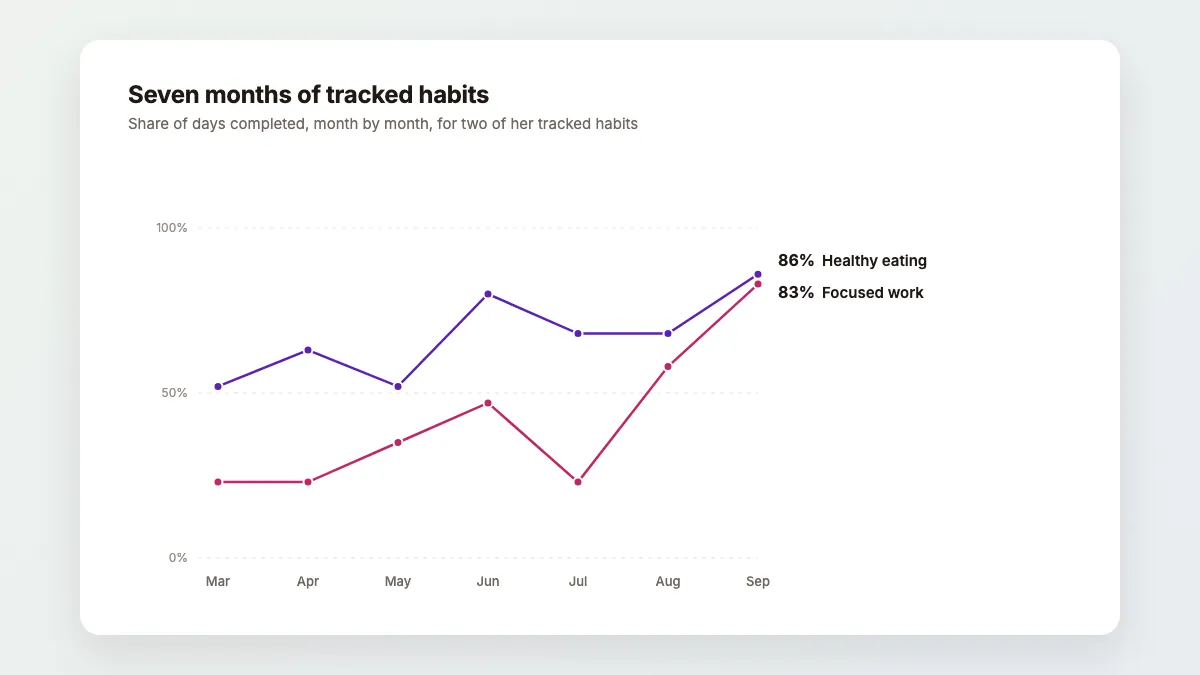
One of them, a freelance designer I’ll call Maya, arrived the way ambitious people usually do: with everything at once. Client work, a product shop, an online course she wanted to build, and a stack of brand-new daily habits on top. She logged ten goals a day in her first week. By day three she turned in a 10% day with the comment “Not the best.”
We didn’t add discipline, we subtracted goals. Less scheduled on her two busiest weekdays. One or two things to actually finish each week, not ten. And each morning, her “high priority” slot renamed to the single thing that mattered most that day. Everything else counted as bonus.
Seven months later, her days looked nothing like that first crash. Healthy eating had climbed from barely half her days to 86%. Focused work on her business, the thing she originally came for, went from roughly one day in four to 83%. There was no heroic week anywhere in between, and there was even a rough month in the middle (you can see it in the chart). Just half a year of unglamorous trimming and adjusting.
Some join for one big, intimidating goal and then avoid it in plain sight. A product founder I’ll call Alex came in to finally build his business, and filled day one with seven brand-new habits instead: a digital detox, journaling, a new sleep schedule, workouts. Everything except the business. He named the pattern himself: “playing not to win.” On day six I asked him to cut the list to exercise plus one work goal per day, so the scary goal was on the board every single day, in a step small enough to actually start. He finished 43% of his plan in that first week. Over the next three weeks he was at 65%, and the work was finally part of it.
Others mainly need structure and body doubling, working alongside someone who expects to hear from them. Their days have no shape, so we build a routine together: time-block the day, anchor habits to fixed times, sometimes even a photo sent to me at the agreed hour. Knowing someone expects that photo at 7am does a surprising amount of the work of being there at 7am. One client, I’ll call her Elena, joined while studying for her professional exams, overwhelmed and losing hours to her phone. We started with a single goal a day and built up from there. She completed about 20% of her plan in week one. By weeks two to four she was above 80%, and months later she was still there. For people like Elena the difference shows up within the first week or two, and the fixed times are how something they always wanted turns into a habit they keep.
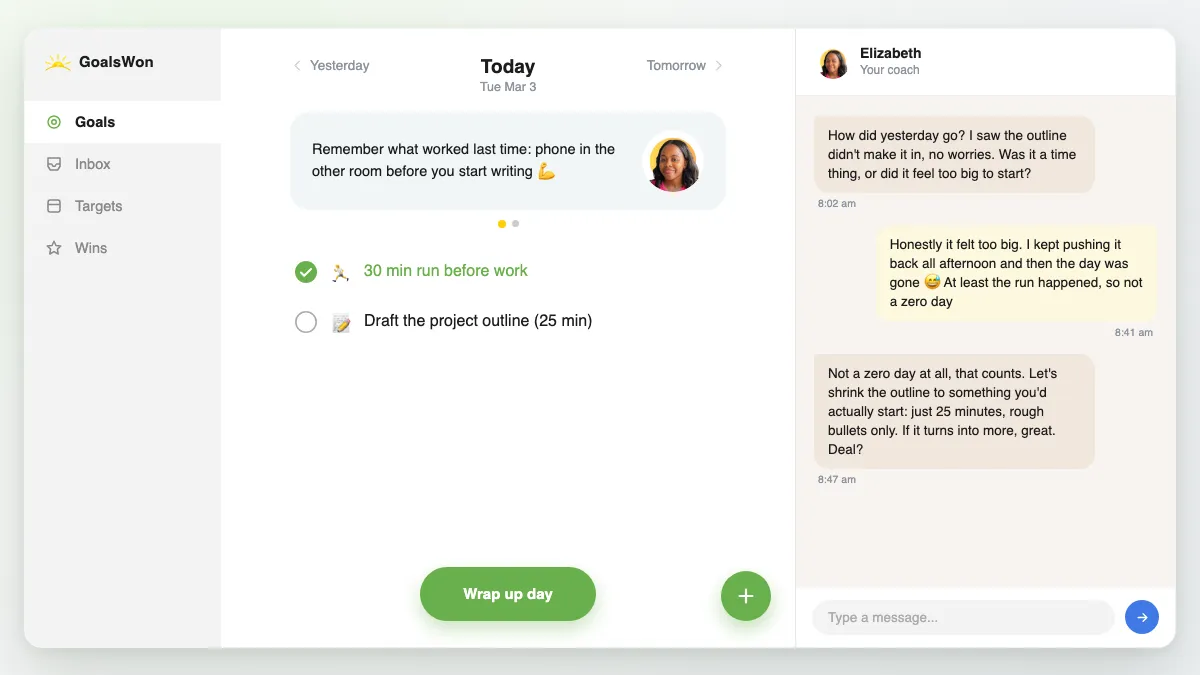
The principle in every one of these cases is consistency over intensity. A day’s plan should be one you’re at least 7 out of 10 confident you can complete, with a smaller backup version for the days that fall apart. New habits come one at a time, so your schedule can adapt around each one before the next arrives. Big projects get broken into a monthly target, then weekly deadlines, then daily steps someone actually checks on. The first week of that is usually a reality check. It’s also usually the week the project gets unstuck.
What does an accountability coach do when you fall behind?
This is the part people fear, and it’s the opposite of what they expect. No guilt. Guilt is usually what broke their previous attempts.
When a client goes quiet or a streak collapses, the questions are practical: What happened? Was the plan too big? Did the week change under you? Then we shrink the next step until it’s almost embarrassing to skip.
One client wrote to me mid-slump, honest about feeling distracted and unmotivated. My reply was mostly one question: what’s one small thing you can commit to today? She answered with the one task she’d been avoiding, finished it that evening, and averaged over 90% completion for the next two weeks. The task was never the problem. Restarting was.
Sometimes the coaching is defending people against their own scorekeeping. A solopreneur spent a weekend on a family emergency instead of his business and reported it like a confession. He’d still shipped one small piece of work. That’s not a failed day, that’s a right priority call. He was back at 100% the next day and stayed there for three weeks.
”I love having a coach because, trust me, if I were alone I wouldn’t have finished it today. But because I told you I would do it, I did it!”
You do the thing because someone you trust knows you said you would, until doing the thing becomes who you are.
What do the coaching calls cover?
At GoalsWon the daily chat is the engine, and calls are the zoom-out layer: plans include a monthly call, and you can upgrade to weekly calls inside the app.
A good monthly call walks a fixed loop, always checked against the year’s big picture:
- – what went well
- – what we learned
- – where the friction was
- – what we’ll change
- – the targets for next month
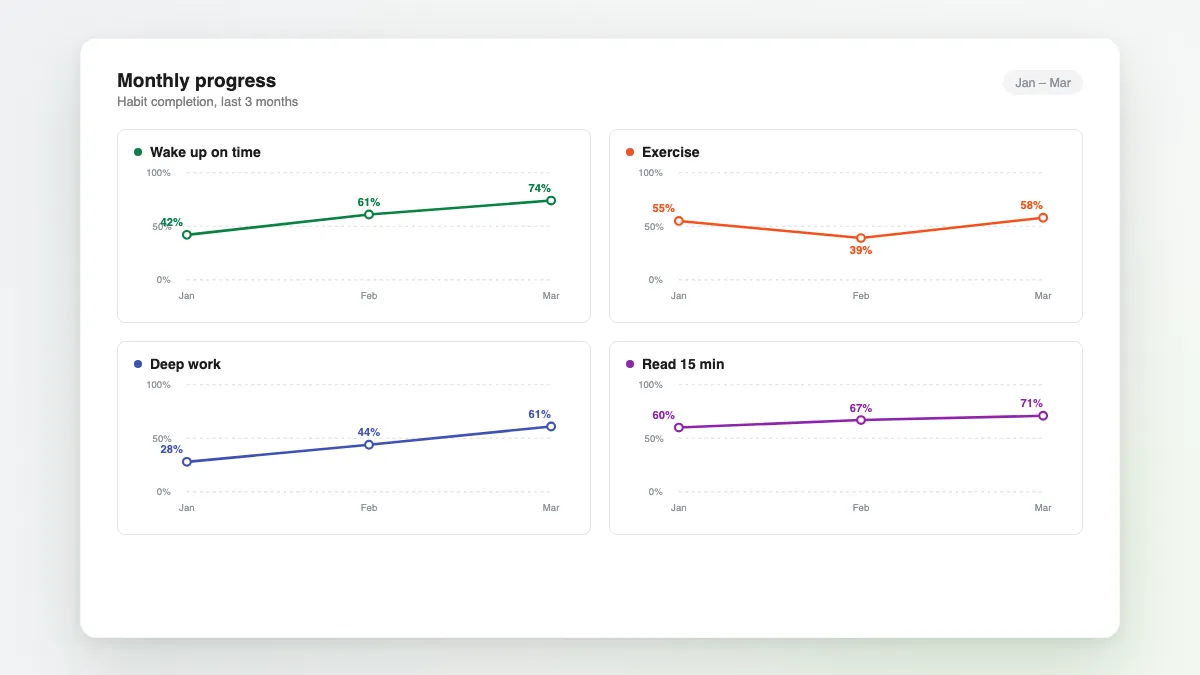
What that sounds like in practice, from recent calls:
- A client needed to finish an important document before leaving on a trip, so she could travel without it hanging over her. The trip was two weeks away. Her estimate was “about a week of work”, but estimates like that are almost always optimistic, so we planned the document across the full two weeks instead, broke it into clear deadlines for each week, and set a midweek checkpoint: what exactly will exist by Wednesday?
- The director of a regional nonprofit could work every waking hour and the role would take it all. On his call we didn’t add a single goal. We scheduled rest as goals instead: one non-negotiable family day, half-days off, and 15-minute versions of his habits.
- This stuck with me: “I used to give myself lists of 45 goals, only get 20 done, and then beat myself up.” The fix isn’t more willpower. A plan only counts if you’re confident you can finish it. If it’s unrealistic, it stops being a plan and becomes a suggestion that you either ignore or stress over.
What does an accountability coach not do?
| Accountability coaching works well when… | It’s the wrong tool when… |
|---|---|
| You already know what to do but aren’t doing it (procrastination, no time, wrong mindset) | You’re feeling lost about direction and need to figure out what to pursue (a career coach fits better) |
| You signed up on your own initiative | Someone else pushed you into it |
| You’re in therapy and want help showing up consistently for what your therapist recommends | You’re dealing with depression or a deep lack of motivation (a mental health professional fits better, and we’ll say so) |
| You want a system, honest questions and a witness to your commitments | You want someone to do the work, or a cheerleader who only claps |
Our coaches are not therapists and don’t pretend to be. When someone needs deeper help, the right move is to refer them to a professional, and that’s what we do.
Where to start
If the pattern in this article sounds like you (you know what to do, but feel stuck or overwhelmed), starting looks like this:
- Take the short quiz. It asks about your goals, your situation and what usually gets in the way, so your coach starts with real context instead of a blank page.
- Get matched with a coach. All our coaches go through the same training, grounded in CBT and positive psychology, but personalities differ and the match matters. If the fit isn’t right, you can switch coaches anytime.
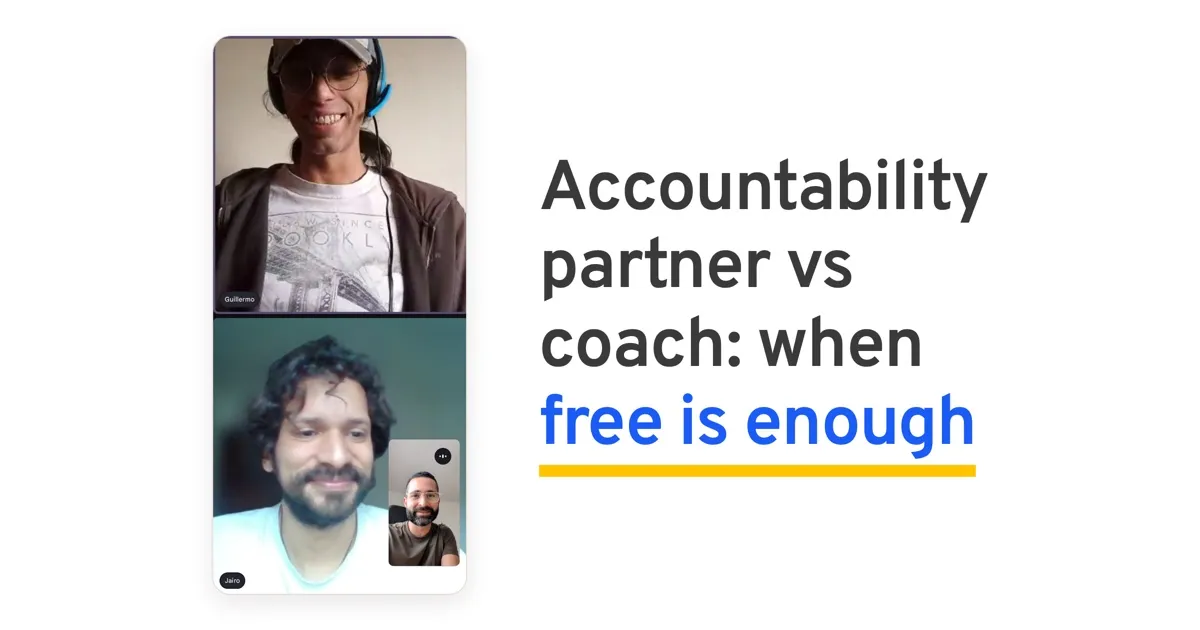
- Meet your coach on a video call. It happens soon after you match, usually the same day or the next. You talk through your situation, your background and what you’re aiming for, then set your first goals together and leave with a plan for the first days.
Want to go deeper on the service itself? Our accountability coach page has the full picture, with pricing and our client data.
The best way to know if it’s for you is the free trial: no contract, so you can test it against your real week and walk away if it doesn’t fit. If it does, plans start at $60/month.
And if you’d rather start with software alone, we keep an honest list of the best accountability apps, including free options.
Frequently asked questions
What happens on the first day with an accountability coach?
You have an intro video call that’s mostly about your coach getting to know you: your context, what you want to achieve and what’s been blocking you. From what you share, you build the starting plan together, one or two goals you’re confident you can complete, sized for momentum rather than ambition. It’s also a nice chance to get to know your coach and see if they’re someone you’ll feel good working with.
Is an accountability coach the same as a therapist?
No. Accountability coaches help you follow through on goals you already understand. They are not trained to treat depression, anxiety or other mental health conditions, and a good one will say so and point you to a professional. That said, coaching does pair well with therapy: many people use their coach to stay consistent with whatever their therapist has recommended.
How much does an accountability coach cost?
GoalsWon has two plans, with no contract and cancel-anytime on both:
- – Yearly: $720 billed once a year, which works out to $60/month, with a 14-day free trial.
- – Monthly: $90/month, with a 7-day free trial.
Other traditional accountability coaches typically run $200–500 per month. The formats differ, though. Their core is a long weekly or monthly call, ours is daily chat with a monthly call included (or weekly calls too, if you upgrade).
How often does an accountability coach check in?
At GoalsWon, every day. You report how the day went in chat, and your coach reads your check-ins and replies every single day. It’s a daily rhythm, not a 24/7 live conversation. Plans also include a monthly call, and you can upgrade to weekly calls inside the app.
What happens when I reach the goal I came for?
You choose. Some people wrap up, and that’s a good ending: the most common reason people leave after a few months is that they met the goal they arrived with. Many others, though, find their priorities simply shift (e.g. the job search becomes a promotion, then the settled job makes room for health or family time). Your coach already knows how you work, so the next priority starts warm instead of from zero.

.B3r7fsvG_g5zEm.webp)